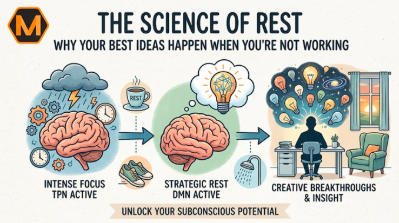
The Science of Rest: Why Your Best Ideas Happen When You’re Not Working
Have you ever spent hours hunched over a desk, staring at a blinking cursor, only to have the perfect solution hit you while you were in the shower or out for a walk? This isn’t a stroke of luck; it is a biological phenomenon. For decades, our productivity culture has sold us the lie that “grinding” is the only path to success.
However, neuroscience suggests that the harder we squeeze our brains for results, the more we actually stifle our creative potential. True breakthroughs rarely happen during the “grind”; they occur during the gaps in between.
The biological secret behind these “Aha!” moments lies in what scientists call the Default Mode Network (DMN). When you stop focusing on a specific task, your brain at rest doesn’t actually shut down; instead, it activates a complex web of neural pathways that connect unrelated ideas.
This is the exact moment many students realize they are overwhelmed and think, “I should just pay someone to write my assignment for me,” allowing the experts at myassignmenthelp to handle the heavy lifting while their own subconscious begins the vital work of subconscious problem solving. By offloading the technical burden, you lower your cortisol levels and open the door for creative breakthroughs.
The Architecture of the Resting Brain
When we are deeply focused, our prefrontal cortex acts like a spotlight, narrowing our vision to the task at hand. While this is great for execution, it is terrible for innovation. Innovation requires a “floodlight” approach, where the brain can scan distant memories, emotions, and disparate facts.
The Incubation Effect
Psychologists refer to this as the Incubation Effect. During this phase, your mind undergoes a period of cognitive ease. While you are folding laundry or walking the dog, your brain is silently “incubating” the problems you were struggling with earlier.
This passive productivity is why a 20-minute break is often more effective than a two-hour study session. It allows for burnout recovery and clears the brain fog that accumulates during intense periods of “directed attention.”
| Brain State | Active Network | Primary Function | Chemical Environment |
| Deep Focus | Task-Positive Network (TPN) | Execution, Logic, Detail | High Dopamine / High Norepinephrine |
| Mind Wandering | Default Mode Network (DMN) | Creativity, Empathy, Synthesis | Balanced Serotonin / Low Cortisol |
| The “Wall” | Over-Exertion | Errors, Frustration, Stagnation | High Cortisol / Adrenaline Fatigue |
Why Modern “Hustle” Kills Cognitive Gain
In a world of constant notifications, we have lost the art of strategic boredom. We fill every empty second with a scroll through social media, effectively starving the DMN of the quiet it needs to function. When the brain is constantly processing new, shallow information, it cannot engage in deep thinking.
For many university students, the pressure to be “always on” leads to a state of chronic mental fatigue. This exhaustion makes it nearly impossible to produce original work. In these high-pressure moments, finding legitimate college papers for sale can provide a necessary academic breathing room, helping to manage a crushing workload and prevent total mental collapse.
Breaking the Cortisol Loop
High stress triggers the release of cortisol, which physically inhibits the parts of the brain responsible for complex thought. To get back into a “flow state,” you must intentionally lower these stress markers. This involves cognitive offloading—the act of delegating smaller, stressful tasks so your “high-level” brain can focus on the big picture.
4 Biohacks to Trigger Creative Insight
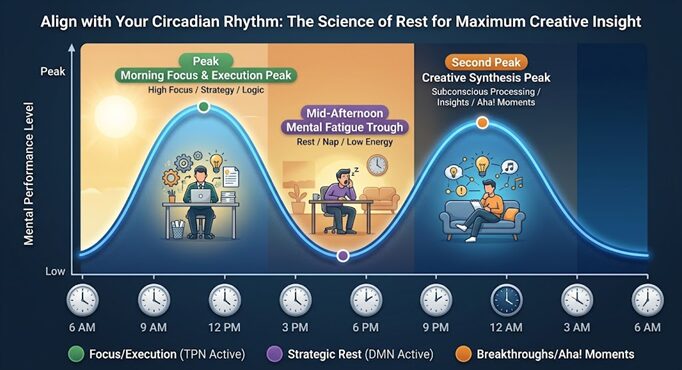
To rank among the highest achievers, you must treat rest as a professional tool rather than a luxury. Here are four ways to use your biology to your advantage:
1. Leverage the “Shower Effect”
Activities that require low-level physical engagement but zero mental effort are the gold standard for creativity. Showers, gardening, or rhythmic walking induce a mild meditative state. This lowers prefrontal cortex inhibition, allowing the subconscious to “whisper” solutions to the conscious mind.
2. Practice Strategic Boredom
Once a day, put your phone in another room and just sit. Do not listen to a podcast; do not read. Allow your mind to wander. At first, it will feel uncomfortable, but this is the “warm-up” for your Default Mode Network. Soon, your brain will begin to play with ideas it had previously tucked away.
3. Align with Your Circadian Rhythm
Not all hours are created equal. Most people have a “peak” window for focus and a “trough” window where focus is impossible. Instead of fighting the trough, use that time for cognitive rest. If your brain feels heavy at 3:00 PM, that is a signal to step away, not to drink more caffeine.
4. Utilize Professional Support Systems
Top-tier professionals and students know they cannot do everything alone. Whether it is using research assistants or academic writing services, delegating the manual labor of a project is a sign of high intelligence. It ensures that your limited “cognitive fuel” is spent on the most important aspects of your work.
The Vagus Nerve and Mental Clarity
A major factor in why we think better when not working is the activation of the parasympathetic nervous system via the Vagus Nerve. When we are “on the clock,” our sympathetic nervous system (fight or flight) is often hyper-active. This restricts blood flow to the parts of the brain that handle creative synthesis.
When you step away from your desk, your heart rate variability (HRV) improves. This physical shift signals to the brain that it is safe to explore “risky” or “out-of-the-box” ideas. This is why a walk in nature often yields more answers than a board meeting. You are literally opening the physical gateways to your higher intelligence.
The Global Shift Toward Mindful Productivity
Across the globe, the narrative is shifting. From the four-day workweek trials in Europe to the “slow living” movements in Asia, society is beginning to realize that human beings are not machines. We are biological systems that require oscillation between high output and deep rest.
When you allow yourself the grace to stop working, you aren’t being lazy. You are engaging in a sophisticated form of neural recharge. You are giving your brain the permission to find the insight that it could never find while under the thumb of a deadline.
Holistic Strategy for Long-Term Success
To maintain this level of performance, you must view your brain as an athlete views their body. Recovery is not the absence of work; it is a vital part of the work itself. By implementing a “work-rest-insight” loop, you ensure that you never hit the wall of total burnout.
- Preparation: Deeply research the topic for 90 minutes.
- Incubation: Walk away. Do something physical.
- Illumination: Keep a notebook nearby for the “Aha!” moment.
- Verification: Return to the desk to refine the idea.
Final Thoughts: Designing a Life of Insight
Ranking on the first page of your own life requires a balance of effort and ease. By understanding the neurological basis of how we think, we can stop fighting our biology and start working with it. The most successful people in history—from Einstein to Steve Jobs—knew that their best thoughts happened during long walks or periods of reflection.
If you find yourself stuck on a complex thesis or a life-altering project, the best thing you can do is walk away. Trust your subconscious processing. Trust that your neural pathways are working even when you aren’t. And most importantly, don’t be afraid to seek the support you need to keep your mental clarity intact. Your best ideas aren’t hiding—they are simply waiting for you to go for a walk.
Frequently Asked Questions
What is the Default Mode Network?
The Default Mode Network (DMN) is a large-scale brain network that becomes active when you are not focused on the outside world. It is responsible for self-reflection, mental simulations, and connecting disparate ideas, which often leads to creative breakthroughs.
How long should a strategic break last to be effective?
Research suggests that even “micro-breaks” of five to ten minutes can lower cortisol levels. however, for deeper cognitive “incubation,” a 20-minute period of low-effort activity—like walking or a light chore—is ideal for resetting focus.
Why do I get my best ideas in the shower?
The shower provides a unique combination of mild physical stimulation and a lack of external distractions. This allows the prefrontal cortex to relax its “filter,” enabling subconscious thoughts and creative solutions to rise to the surface of your conscious mind.
Can “working harder” actually decrease productivity?
Yes. When the brain is pushed past its limit, it enters a state of diminishing returns. Chronic stress and mental fatigue restrict the neural pathways required for complex problem-solving, making it physically harder to produce high-quality work without adequate rest.
About The Author
Lucy Wilson is a dedicated academic consultant and researcher with a focus on student mental performance and holistic learning strategies. As a senior contributor for MyAssignmentHelp, she specializes in bridging the gap between cognitive wellness and academic achievement, helping learners worldwide find a sustainable balance between their health and their studies.